Burst Pipe Water Damage in Round Rock, TX
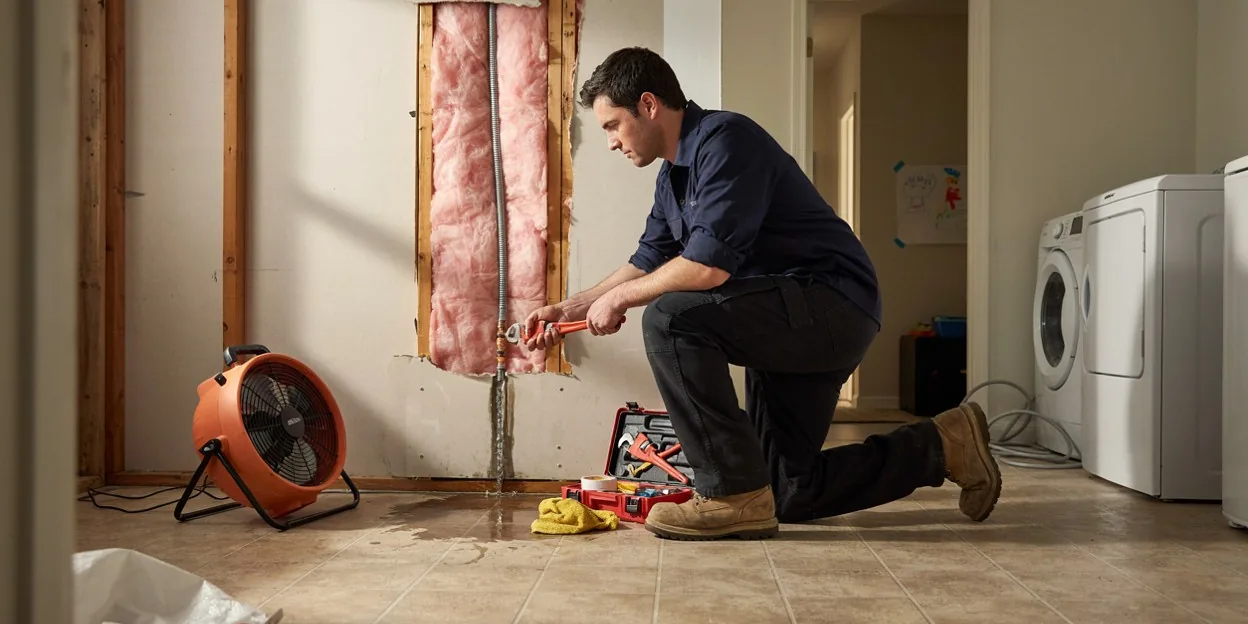
The power came back on Wednesday afternoon and the house warmed up. An hour later water was pouring through the ceiling fan in the living room. A line in the attic had frozen sometime Monday night, split, and waited for the thaw. This site routes your call to an independent local provider who cleans up burst pipe water damage across Round Rock and Williamson County.
Where a freeze-split line sends the water in a Round Rock house
An attic break drops water onto the insulation first. Blown insulation holds it like a sponge and then releases it across the top of the ceiling drywall, which sags, stains, and eventually opens. From there the water runs down inside the walls to the slab and spreads under the flooring. An exterior-wall break soaks the wall cavity and the bottom plate, and shows up as a wet baseboard on the inside and a wet brick ledge on the outside.
The crew starts with the valve, then pulls the standing water off the floor with extraction gear. Wet insulation comes out of the attic, and a sagging ceiling is opened at the low point to drain it. After that the meter goes on every wall below the break, and structural drying equipment goes in where the readings say.
Before the crew gets there, after the pipe lets go
Close the main valve. In Round Rock it is usually in a box at the curb, and a meter key or channel-lock pliers turns it. If you cannot find it, the city water utility can shut it at the meter. Turn off the breaker for any room with a wet ceiling fan or light. Put a bucket under the drip, pull the furniture back, and photograph the ceiling before it is cut. Leave the wet insulation alone. Then call.
What comes out after a burst line, and what dries
Wet blown insulation comes out because it will not dry in the attic. Ceiling drywall that sagged or split comes out, and so does laminate flooring that swelled. Wall drywall that reads wet but is still sound can often be dried through small holes behind the baseboard. Carpet may be saved if extraction is quick; the pad rarely is. Cabinets get metered underneath before anyone decides. For each material that leaves, ask which reading sent it.
February 2021 taught every subdivision the same lesson
Winter Storm Uri sat over Central Texas from February 14 to 19, 2021, and Round Rock spent days below freezing with the power going in and out. Attic lines in the 1990s and 2000s subdivisions froze first, because that is where builders ran the plumbing on a slab house, and exterior-wall lines in older Old Town and Chandler Creek homes went next. The city's water system stayed up because of a backup generator at the Lake Georgetown pumps, so when the thaw came the pressure was there to push water through every split.
Shorter freezes in December 2022 and January 2024 did the same thing on a smaller scale. If a line cracked without bursting, the drip may only show up later as a soft wall or a high bill, and that is a leak detection call. If the break was above a bathroom or a hallway, ceiling water damage repair covers the drywall side of the job.
A pipe that bursts is the clearest example of the sudden loss most Texas homeowners policies respond to. Some insurers ask whether the house was heated when it froze, so tell the crew if the power was out. Have them log the readings and photos from the first visit.
Call when the thaw turns into a leak
Have the address ready and be ready to say where the water came through, whether the valve is off, and whether the power was out when the pipe froze. Mention any water still standing on the floor. Call (512) 562-9101 and tell us what you see.